
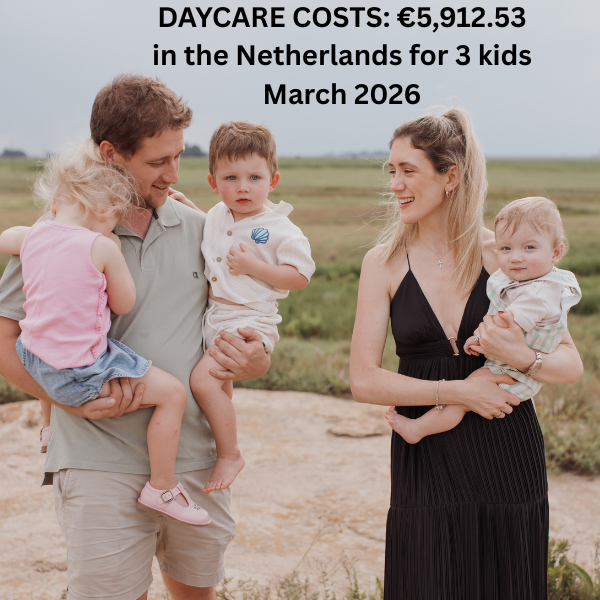
The Real Cost of Daycare in the Netherlands (2026): A Complete Breakdown for Working Families
After I shared a quick breakdown on Instagram, I received so many questions that I decided to write a full blog post to properly explain how childcare costs actually work in the Netherlands.
Because yes — when you first see the invoice, it looks absolutely shocking.
But once you understand the Dutch system, the refunds, and how to structure your finances… the reality is very different.
This is our real-life situation as a working family, and I’m also going to walk you through the rules, the system, and how you can use it wisely as part of building long-term financial stability and generational wealth.
Our Situation: A Real Monthly Example
We are a working couple living in the Netherlands. We moved here on my husband’s highly skilled migrant visa, and we arrived when we were under 30 — which means lower minimum salary thresholds applied at the time.
We also own a home, which is important because mortgage interest payments are deductible from our taxable income (belastbaar inkomen) — this plays a role in your overall financial picture.
Our daycare setup:
- 👶🏼👶🏼 2 boys (1 & 2 years) → 3.5 days per week
- 👧🏼 1 girl (3 years) → 4.5 days per week
Monthly numbers:
- Total daycare invoice: €5,912.53
- Childcare allowance received: €4,986
- Our actual out-of-pocket cost: €926.53
Yes — that’s the real number we pay.
How the Dutch Childcare System Works
Childcare in the Netherlands is subsidised through something called kinderopvangtoeslag (childcare allowance), managed by the Belastingdienst.
It is not free — but it is heavily subsidised depending on your situation.
Here’s how it works:
✔️ The government reimburses a percentage of your childcare costs
✔️ This percentage is based on your combined household income
✔️ Both parents must be working, studying, or in an eligible reintegration program
✔️ The number of children in daycare impacts your reimbursement percentage
✔️ There is a maximum number of hours per child that qualifies
✔️ There is also a maximum hourly rate the government will reimburse
2026 Rules & Key Figures
These are essential to understand:
1. Maximum reimbursable hourly rate
- Daycare (kinderopvang): €11.23 per hour (2026)
If your daycare charges more than this:
👉 You pay the difference 100% out of pocket
2. Maximum reimbursable hours
- Up to 230 hours per child per month
Anything above that:
👉 Not reimbursed
3. Reimbursement percentage
- Can be up to 96% for lower-income households (around €56K or less)
- Decreases as income increases
- Second and third children receive a higher reimbursement percentage
This is a big reason why larger families often benefit more proportionally.
Why Our Net Cost Is “Only” €926.53
Even though our invoice is nearly €6,000 per month, our actual cost is much lower because:
✔️ We qualify for a relatively high reimbursement percentage
✔️ We have three children in care, increasing our benefit
✔️ The Dutch system is designed to support dual-income households
Important Reality Checks ⚠️
This is where many people misunderstand the system:
1. The invoice is NOT your real cost
Always calculate your net amount after allowance
2. Daycare pricing matters
If your daycare charges above the government hourly cap:
👉 You always pay that difference yourself
3. Your income directly affects your benefit
- Higher income = lower reimbursement %
- You must update your income annually (or when it changes)
If you don’t:
👉 You risk having to pay money back later
4. Both parents must qualify
To receive childcare allowance:
✔️ Both partners must be working or studying
Tax & Financial Considerations (Often Overlooked)
This is where things get even more interesting financially:
- As homeowners, we benefit from mortgage interest deduction (hypotheekrenteaftrek)
- This lowers our taxable income (belastbaar inkomen)
- A lower taxable income can indirectly influence benefits and overall financial efficiency
Combined with:
- childcare allowance
- dual incomes
- structured budgeting
…it creates a much more manageable financial picture than people expect.
The Bigger Picture: It’s About Strategy, Not Just Costs
This is not just about daycare.
It’s about:
- understanding the system
- planning your income and expenses
- making informed decisions
- and using available structures to your advantage
Childcare might look like a massive expense…
…but when managed properly, it becomes part of a bigger financial strategy.
Valuable Takeaways 💡
👉 Always calculate your net childcare cost, not the invoice
👉 Check your daycare’s hourly rate vs the government maximum
👉 Keep your income updated with the Belastingdienst
👉 Understand how multiple children impact your reimbursement
👉 Factor childcare into your long-term financial planning
Final Thought
The Dutch system can feel overwhelming at first — especially for expats — but once you understand it, it becomes clear that it’s designed to support working families.
For us, it’s not just about covering daycare.
It’s about:
- building stability
- managing money intentionally
- and creating a foundation for generational wealth
And that starts with understanding exactly where your money is going — and how to make it work for you.